

When organizations track too many metrics, they create a paradox: more data leads to worse decisions. Research from the Strategic CFO Institute reveals that companies monitoring 100+ KPIs experience significant decision paralysis, with teams spending more time preparing metrics that “are most likely being ignored” than acting on insights (Strategic CFO, 2024). This overwhelming flood of information allows anyone to “find an answer to support the position they’re trying to push forward,” as one executive noted, but context disappears and effective decision-making becomes impossible (Marketoonist, 2020).
The human cost is staggering. Decision fatigue affects one in three business leaders, causing irritability, exhaustion, and impulsive choices that can devastate business performance (WeCovr, 2025). As Bart Valgaerts explains, “You can’t look at 20 metrics at once and make sense of them. Your brain simply cannot process 20 KPIs simultaneously, especially when they all have different colors and indicators screaming for attention.”
The financial impact compounds quickly. Teams waste countless hours maintaining dashboards filled with vanity metrics that look impressive but lack business impact. Meanwhile, critical indicators get lost in the noise, leading to missed opportunities and delayed responses to real problems.
Identifying critical KPIs starts with understanding your decision-making hierarchy. Bart Valgaerts describes a systematic approach: “First, you need to identify your key metrics – the ones that signal when something needs attention. Then you establish a clear sequence: if metric A shows a problem, you drill down to metrics B, C, and D. If metric F has an issue, you examine metrics G, H, and I.”
This framework transforms an overwhelming dashboard into a logical decision tree. Instead of monitoring everything simultaneously, you focus on leading indicators that trigger specific investigation paths. MIT Sloan research confirms this approach: companies using structured KPI frameworks are 34% more likely to realize business benefits including improved alignment and financial performance (MIT Sloan, February 2024).
The key is establishing clear relationships between metrics. Your primary KPIs should answer strategic questions, while secondary metrics provide diagnostic depth when needed. This hierarchical structure ensures you’re not just collecting data but building a system that guides action. As organizations mature in this approach, they typically find that 6-8 strategic KPIs, supported by operational metrics accessible on demand, provide optimal decision-making capability without overwhelming cognitive capacity.
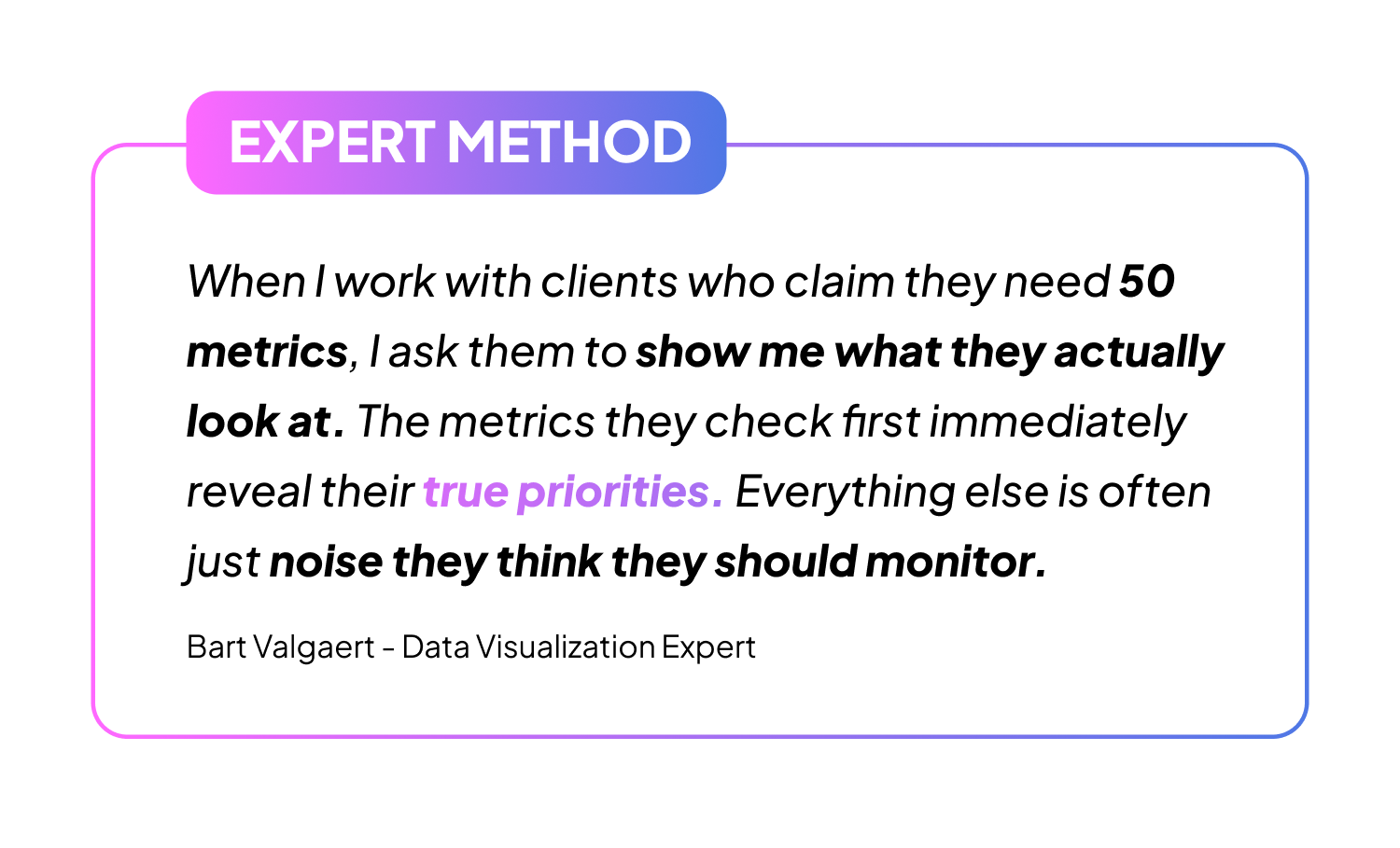
The most revealing moment in KPI discovery comes from a simple request. “When I work with clients who claim they need 50 metrics, I ask them to show me what they actually look at,” explains Bart Valgaerts. “The metrics they check first immediately reveal their true priorities. Everything else is often just noise they think they should monitor.”
This technique cuts through organizational politics and wishful thinking. Watch where managers naturally navigate when they open their dashboards. Note which reports trigger immediate action versus those gathering digital dust. These behavioral patterns expose the genuine decision drivers in your organization, regardless of what strategic documents claim.
The method extends beyond individual habits. Map how information flows when problems arise. If sales numbers dip, which metrics does the sales director examine next? When customer complaints spike, what data does the service team pull? These sequences reveal your organization’s actual decision-making DNA.
Building on these observations creates powerful efficiency. Instead of presenting 50 metrics hoping users find what matters, you architect dashboards that mirror natural investigation patterns. This approach reduces time-to-insight dramatically while ensuring critical indicators never get buried under less important data.
Executive dashboards and operational metrics serve fundamentally different purposes. “C-level executives need aggregated data focusing on high-level KPIs,” Bart Valgaerts notes. “Operational teams need much more detailed information that updates frequently. The mistake happens when organizations try to use the same metrics for both audiences.”
Strategic KPIs for C-suite executives typically include return on investment, market share, and quarterly revenue growth – metrics that guide long-term planning and board reporting. These indicators change slowly and require context spanning months or quarters. Executives need to see trends, not daily fluctuations, with the ability to drill down into operational details only when strategic indicators signal problems.
Operational teams require different intelligence entirely. They track daily production volumes, hourly customer service response times, and real-time inventory levels. These metrics demand immediate action when thresholds breach. A warehouse manager needs to know about stock-outs instantly, while the CEO only needs to understand inventory efficiency trends quarterly.
The solution isn’t separate systems but layered visibility. “I build dashboards with multiple levels,” Valgaerts explains. “Executives see aggregated views initially but can drill down through operational layers when needed. This approach respects everyone’s time while ensuring information accessibility when strategic decisions require operational context.”
Distinguishing actionable KPIs from vanity metrics requires brutal honesty. “A good consultant questions everything,” states Bart Valgaerts. “When clients insist they need all their metrics, I challenge them to prove why each one is necessary. Most can’t justify more than 9-10 truly critical indicators that drive actual decisions.”
Actionable KPIs share three characteristics: they trigger specific responses, connect directly to business outcomes, and change frequently enough to warrant monitoring. Customer acquisition cost drives pricing decisions. First-call resolution rates determine training investments. Inventory turnover influences purchasing schedules. Each metric links to clear actions and accountabilities.
Vanity metrics, conversely, make dashboards look impressive while adding no decision value. Website visitor counts without conversion context, social media followers without engagement rates, or production volumes without quality indicators create false confidence. These metrics often persist because they’re easy to measure and trend upward, not because they guide strategy.
The Strategic CFO Institute recommends focusing on 6-8 numbers that truly drive the bottom line, using leading indicators that predict future performance alongside lagging indicators that confirm strategy effectiveness (Strategic CFO, 2024). This balanced approach ensures you’re both steering the ship and confirming you’re on course, without drowning in meaningless data.
Implementation succeeds through iteration, not perfection. “Never deliver a dashboard all at once,” advises Bart Valgaerts. “Start with an MVP – most valuable product – showing just core metrics. Deliver something functional within two weeks, gather feedback, then build the next iteration. This approach ensures you’re building what users actually need, not what they initially requested.”
Begin by auditing existing dashboards to identify which metrics genuinely influence decisions. One telecommunications client discovered that from 6,000 apps in their environment, only 10% saw regular use. “If a metric hasn’t been accessed in 90 days, delete it,” Valgaerts recommends. “If someone complains, you can restore it. But in nine out of ten cases, they’ve forgotten it existed.”
Technology choices depend on organizational maturity. Smaller companies might start with Excel-based reporting before graduating to Power BI or Tableau. Larger enterprises need robust governance frameworks documenting metric ownership, calculation methods, and review cycles. The Belgian government’s approach provides a model: designated release managers determine production-ready dashboards, while mandatory documentation ensures continuity when team members change.
Success measurement comes from both efficiency gains and decision quality. Track time from data to decision, reduction in report preparation hours, and most importantly, whether critical business outcomes improve after implementing focused KPIs.
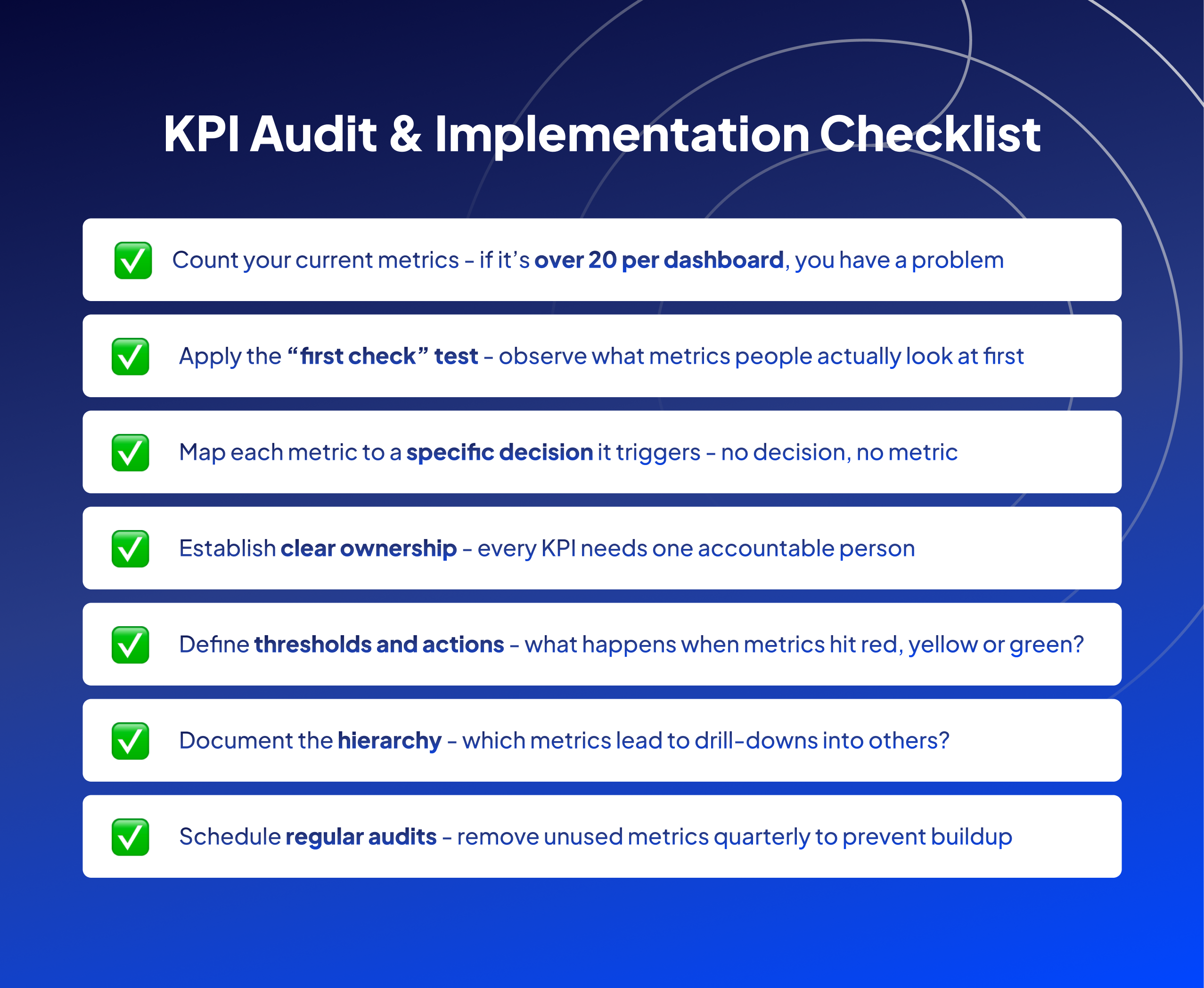
Escaping metric overload requires courage to challenge the status quo and focus on what truly drives business value. By implementing the “show me what you check first” method and building hierarchical KPI structures, you transform overwhelming dashboards into powerful decision engines. Remember Bart Valgaerts’s fundamental rule: if you can’t justify why a metric deserves dashboard space, it doesn’t belong there. Start your metric audit today – identify the KPIs that trigger real decisions, eliminate the rest, and watch your organization’s decision-making speed and quality dramatically improve.